I am an astrophysicist. Currently a Postdoctoral Researcher at Università degli Studi di Milano-Bicocca, in the group of prof. Alberto Sesana.
Recent Posts
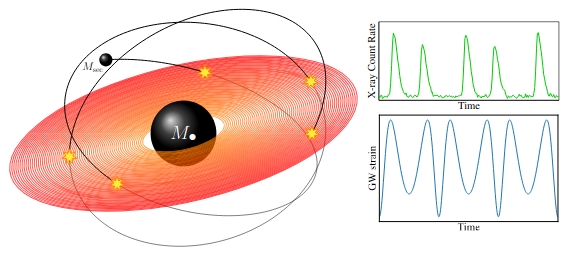
Multimessenger prospects of quasi-periodic eruptions
Vojtěch Witzany, Alessia Franchini, Matteo Bonetti, and Luca Broggi
Quasi-Periodic Eruptions (QPEs) are recurring soft X-ray transients that may be generated by inspirals of stellar-mass objects spiraling into supermassive black holes, known as extreme mass ratio inspirals (EMRIs). Independently, EMRIs and the gravitational-wave signals they generate are one of the key targets for the Laser Interferometer Space Antenna (LISA). What is the potential of a coincident detection of EMRIs both as a QPE and by LISA?
read more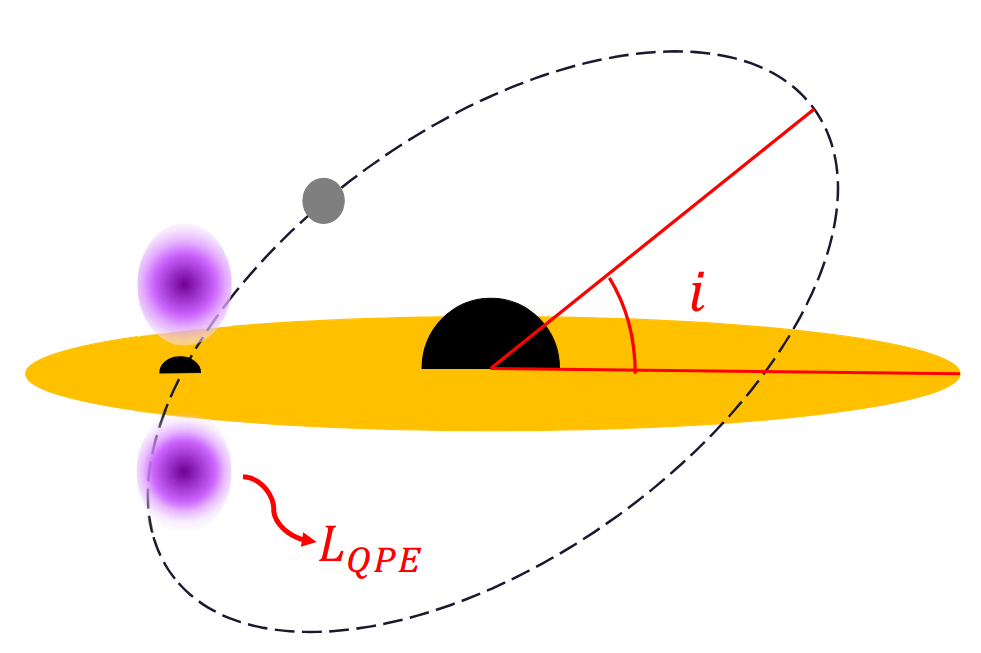
Two-body relaxation in the EMRI-TDE disk model for Quasi Periodic Eruptions
Chiara Maria Allievi, Luca Broggi, Alberto Sesana, and Matteo Bonetti
Quasi Periodic Eruptions (QPEs) are luminous bursts of soft X-rays recently discovered in galactic nuclei. They repeat on timescales of hours to weeks, superimposed to an otherwise stable quiescent X-ray level, consistent with emission from a radiatively efficient accretion flow around relatively low-mass massive black holes (MBHs). Although their physical origin is still debated, their quasi- periodicity naturally arises within the ’impact model’, in which the X-ray bursts are generated by the interaction between a stellar black hole (sBH) or a star in a close orbit around the central MBH and the accretion disk formed by a tidal disruption event (TDE).
read more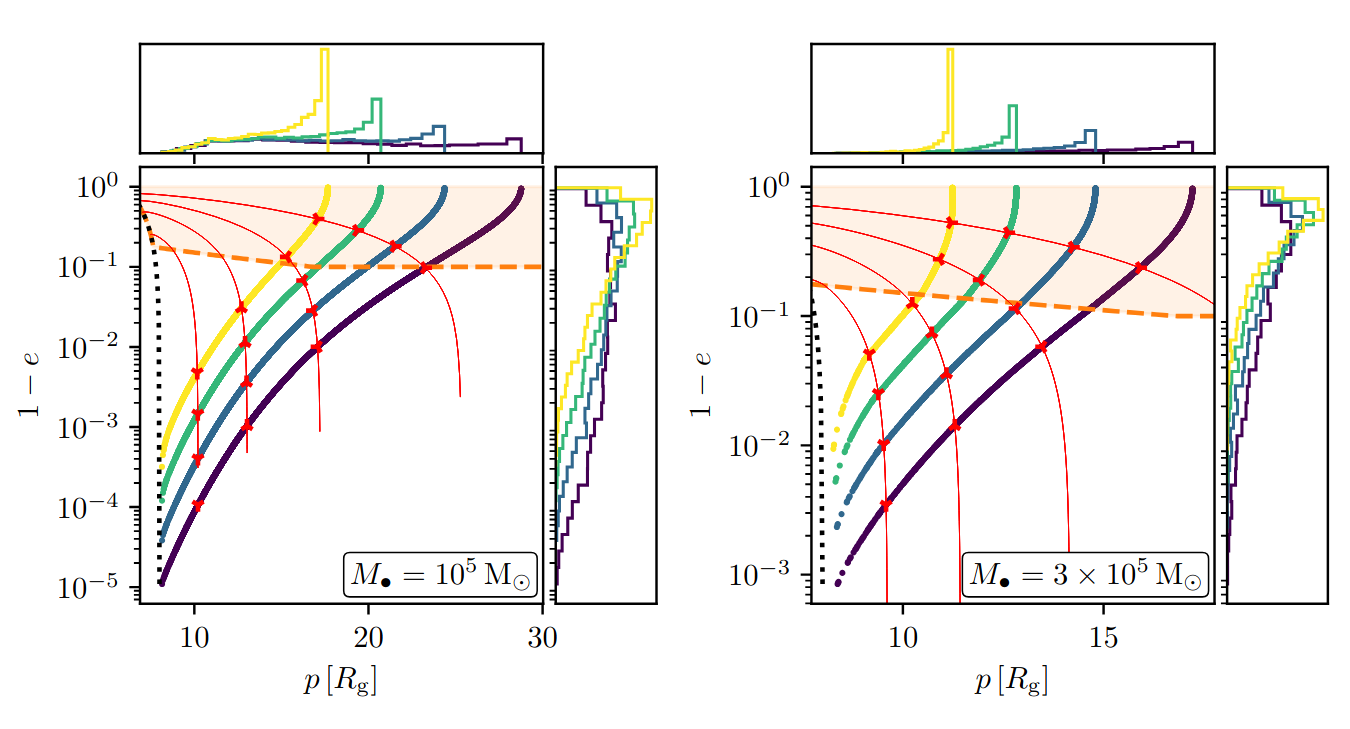
Eccentricity distribution of extreme mass ratio inspirals
D. Mancieri, L. Broggi, M. Vinciguerra, A. Sesana, and M. Bonetti
We present realistic eccentricity distributions for extreme mass ratio inspirals (EMRIs) forming via the two-body relaxation channel in nuclear star clusters, tracking their evolution up to the final plunge onto the central Schwarzschild massive black hole (MBH). We find that EMRIs can retain significant eccentricities at plunge, with a distribution peaking at \(e_\mathrm{pl}≈0.2\), and a considerable fraction reaching much higher values.
read more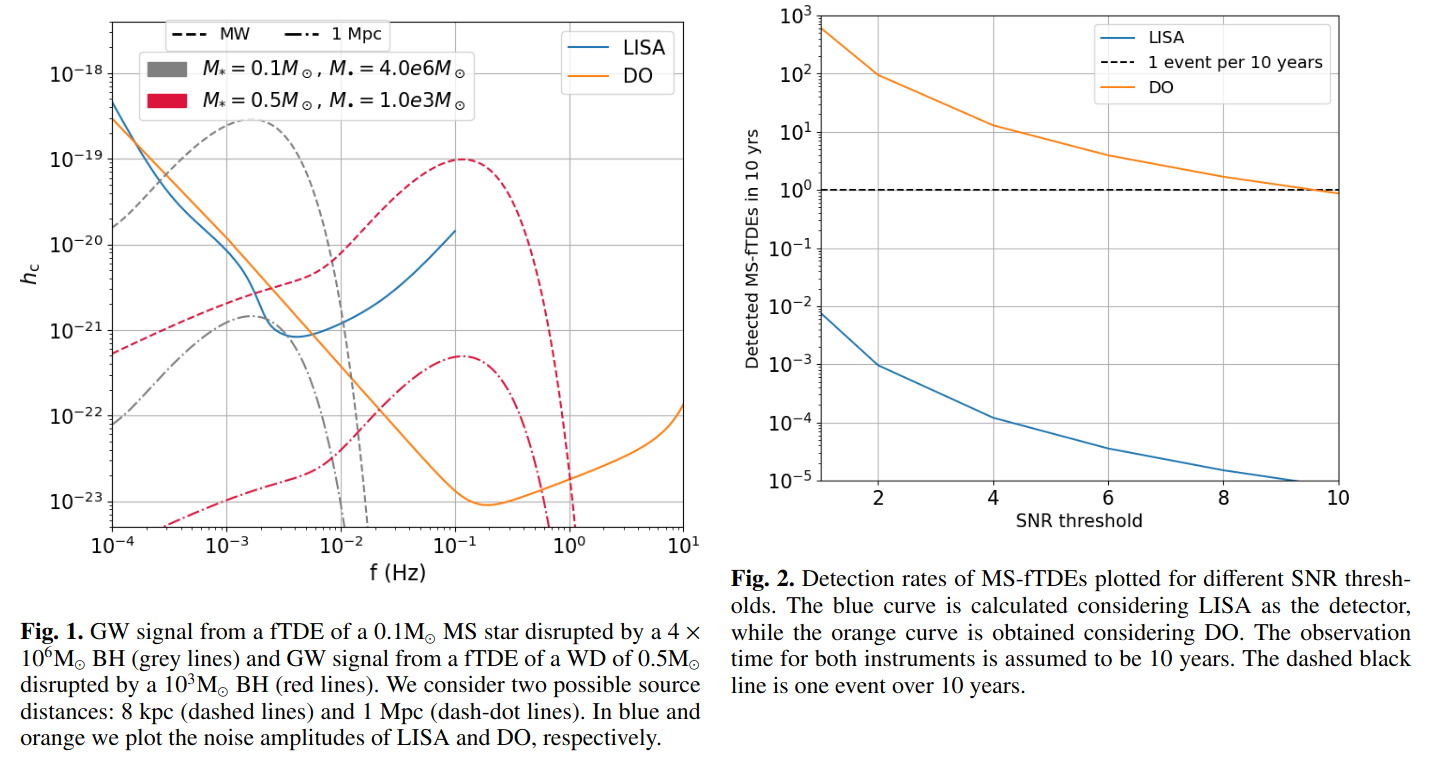
Updated predictions for gravitational wave emission from TDEs for next generation observatories
M. Toscani, L. Broggi, A. Sesana, and E. M. Rossi
In this paper, we investigate the gravitational wave (GW) emission from stars tidally disrupted by black holes (TDEs), using a semi- analytical approach. Contrary to previous works where this signal is modeled as a monochromatic burst, we here take into account all its harmonic components. On top of this, we also extend the analysis to a population of repeated-partial TDEs, where the star undergoes multiple passages around the black hole before complete disruption.
read more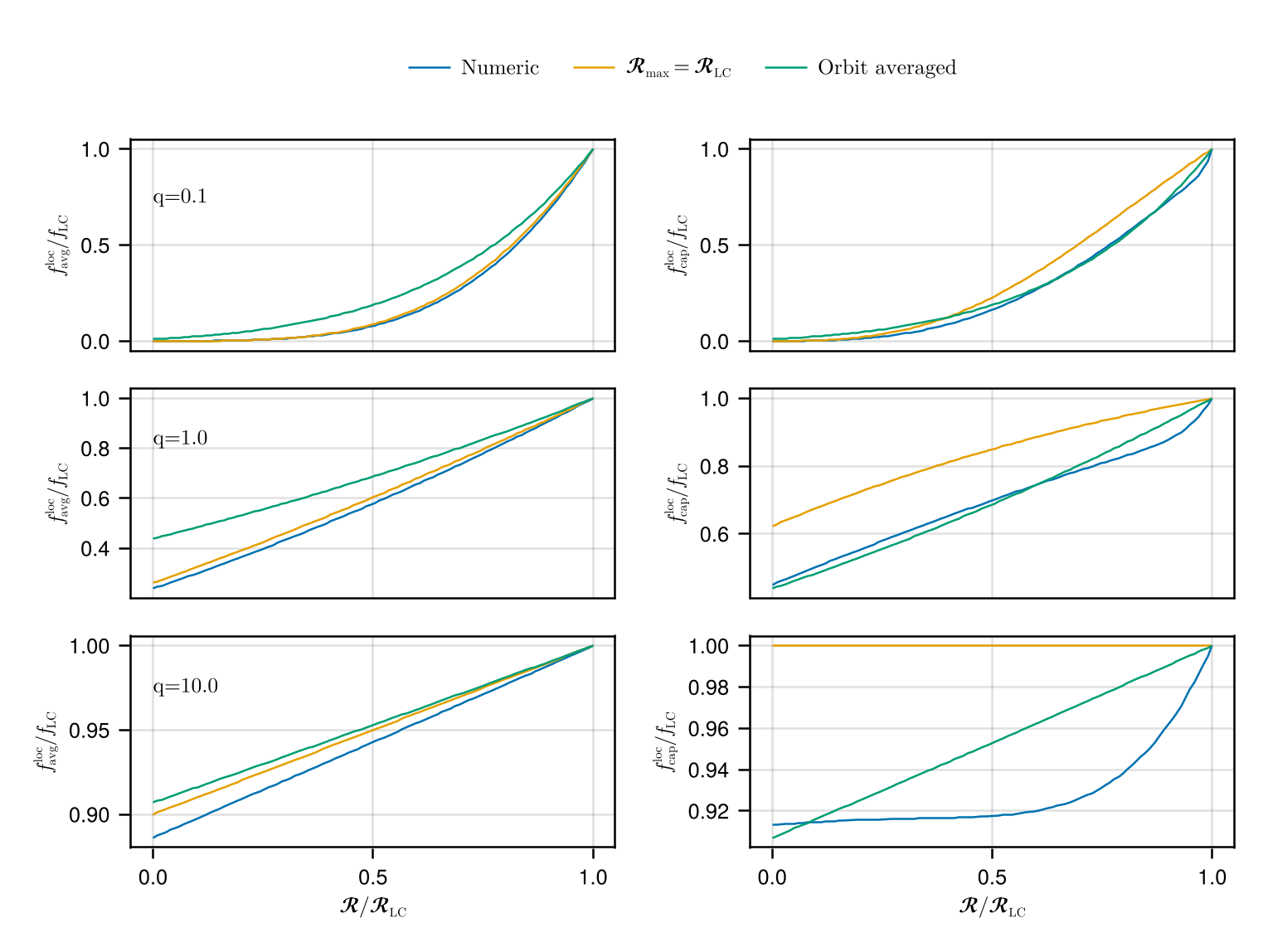
Breaking boundaries: extending the orbit averaged Fokker-Planck equation inside the loss cone
Broggi, Luca
In this Letter, we present a new formulation of loss cone theory as a reaction-diffusion system, which accounts for loss cone events through a sink term and can be orbit-averaged. It can recover the standard approach based on boundary conditions, and is derived from a simple physical model that overcomes many of the classical theoretical constraints. We test our formulation by computing the relaxed distribution of disruptive orbits in phase space, that has a simple analytic form and agrees with the pericentre of tidal disruption events at disruption predicted by non-averaged models.
read more