Two-body relaxation in the EMRI-TDE disk model for Quasi Periodic Eruptions
Chiara Maria Allievi, Luca Broggi, Alberto Sesana, and Matteo Bonetti
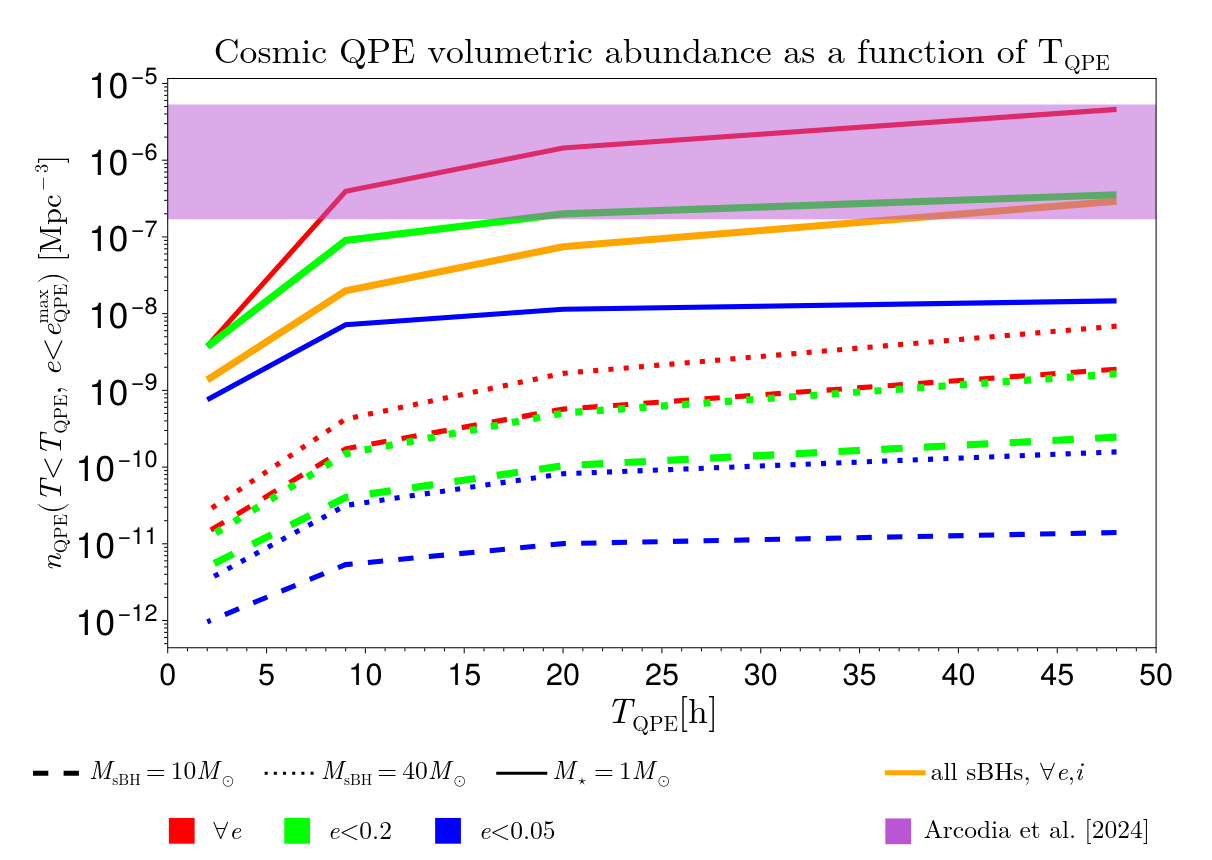
Quasi Periodic Eruptions (QPEs) are luminous bursts of soft X-rays recently discovered in galactic nuclei. They repeat on timescales of hours to weeks, superimposed to an otherwise stable quiescent X-ray level, consistent with emission from a radiatively efficient accretion flow around relatively low-mass massive black holes (MBHs). Although their physical origin is still debated, their quasi- periodicity naturally arises within the ’impact model’, in which the X-ray bursts are generated by the interaction between a stellar black hole (sBH) or a star in a close orbit around the central MBH and the accretion disk formed by a tidal disruption event (TDE). While this model is consistent with the phenomenology of QPEs, it remains unclear whether such specific physical configurations are sufficiently commonto explain the observed QPE number density. We present the first end-to-end quantitative calculation of the expected QPE rate and abundance within the framework of the impact model. To this purpose, we combine the rates of TDEs and extreme mass-ratio inspirals (EMRIs) around MBHs spanning a range of masses masses. We employ the public code PhaseFlow to simulate seven systems with MBH masses between 105 M⊙ and 108 M⊙, each sourronded by a three-component population: one composed of 1M⊙ stars, and two consisting of sBHs with masses of 10M⊙ and 40M⊙. Based on the emission constraints available in the literature, we restrict to sBH EMRIs on prograde orbit with eccentricity e < 0.5 and inclination ι < 20◦ with respect to the accretion disk. For stellar EMRIs the constraints instead arise from the requirement that the star avoid tidal disruption. We find that the predicted QPE number density spans the range 10−12Mpc−3 to 10−6Mpc−3, depending on the assumed orbital period interval and on the adopted eccentricity and inclination thresholds. QPEs generated by stellar EMRIs can reach number densities comparable to those inferred from current observations. In contrast, imposing the orbital constraints required for the sBH channel significantly suppresses the number of observable events, resulting in abundances approximately three orders of magnitude lower than in the stellar case. If the eccentricity and inclination constraints are relaxed, sBH-driven QPEs become compatible with the lower bound of the observationally inferred range